
Most homeowners spend more time picking a kitchen countertop than vetting the crew about to bolt a structure to their house. That’s backwards.
Hiring deck builders in Portland isn’t a commodity decision. The Pacific Northwest’s rain, temperature swings, and long wet season put demands on both materials and the people installing them. A contractor who spent a decade building decks in Phoenix isn’t automatically ready to build yours here. They’ll learn the regional nuances on your project, not before it.
We’ve been building decks across the Pacific Northwest since 1997, so we know what separates a solid bid from a future headache. Here’s the framework we’d want a homeowner to use, whether they end up calling us or not.
What separates reliable deck builders from ones you’ll regret hiring
Portland’s wet season runs long. Moisture gets under boards, into post bases, and behind ledger connections. A contractor who understands this designs around it with proper flashing details, smart drainage slopes, and material choices that account for repeated wet-dry cycles. A contractor who doesn’t will cut corners on details that won’t surface as problems until year two or three.
Ask directly: how long have they been building in Oregon or Washington? Do they know which composite brands hold up in high-moisture environments? Can they explain ledger flashing without hesitating? These aren’t trick questions. They’re basic knowledge for anyone who’s done this work here for years.
Portfolio depth tells you more than a price sheet
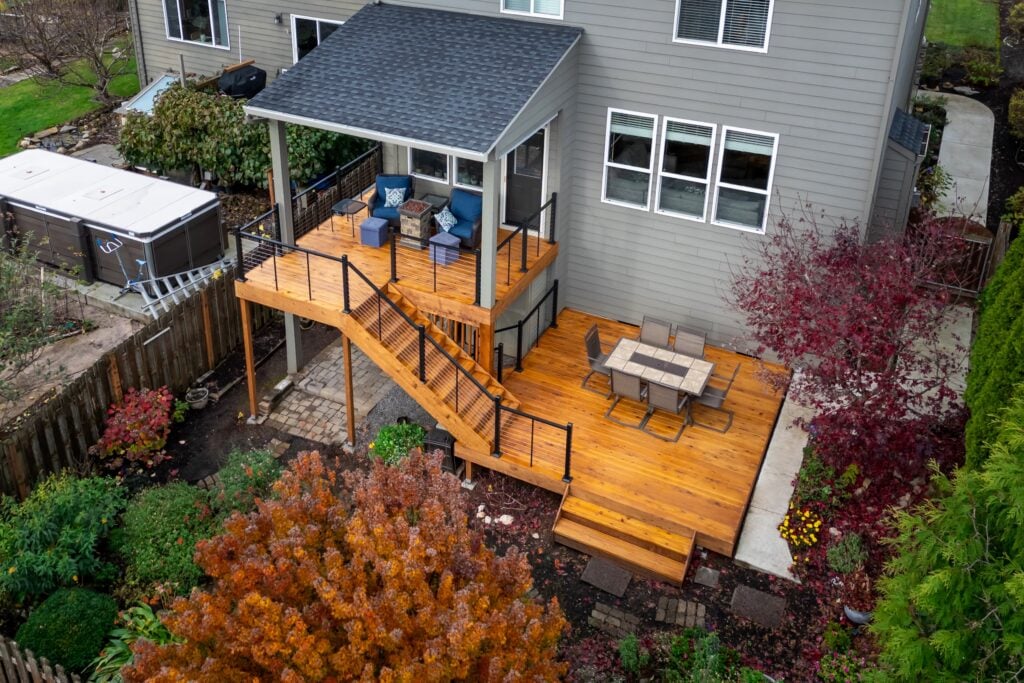
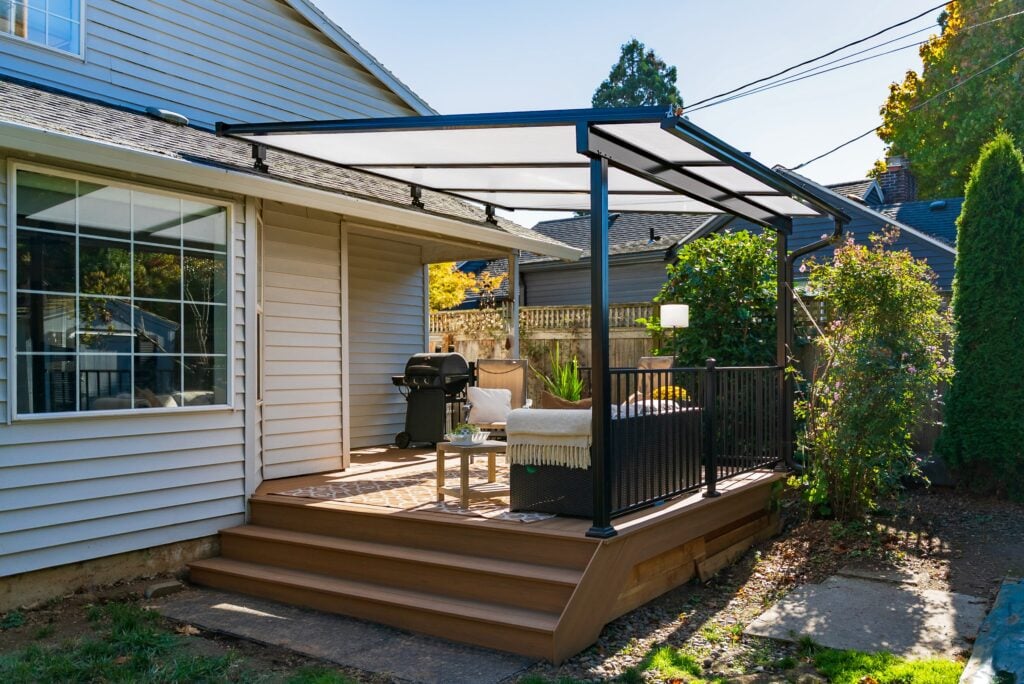
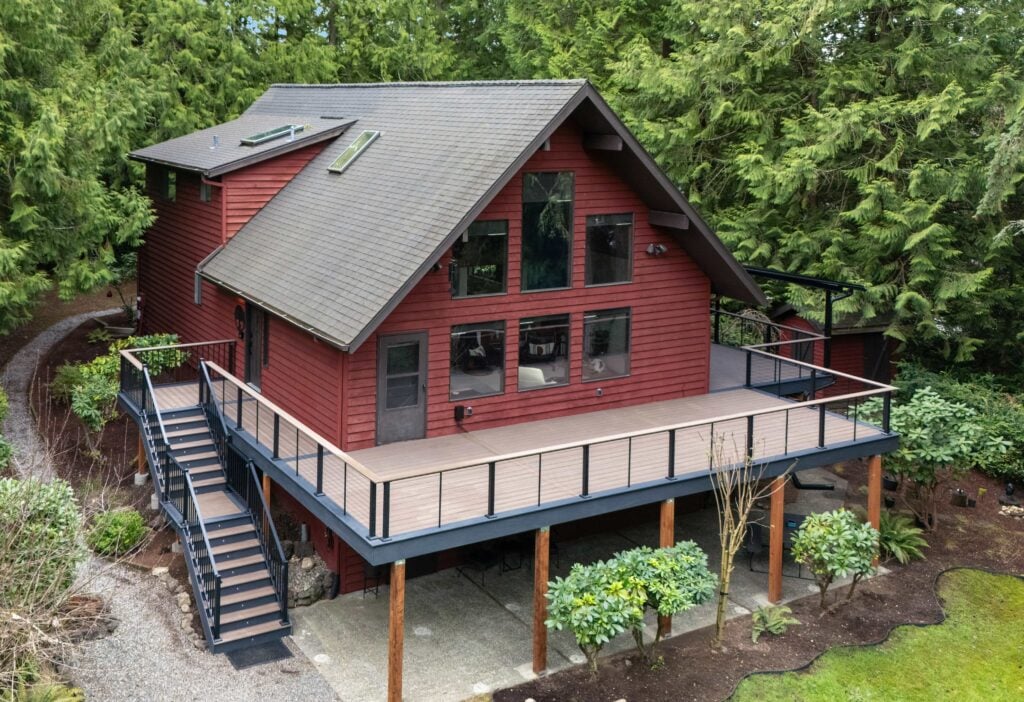
A portfolio of ten nearly identical rectangular decks is fine, until your project involves a sloped lot, a roofline integration, or multi-level stairs. Ask to see projects similar in complexity to yours. Look for clean framing photos, not just glamour shots of the finished surface, and ask whether those projects passed final permit inspection and closeout. An incomplete permit history is a warning sign worth taking seriously.
Credentials that actually matter
Before a conversation goes further, confirm three things: an active Oregon or Washington contractor’s license, general liability insurance, and workers’ compensation coverage. You can verify the license directly through the Oregon Construction Contractors Board or Washington’s Department of Labor and Industries. Ask for a certificate of insurance before work begins, not just a verbal assurance. If a contractor hesitates on any of these, that hesitation is your answer.
Choosing the right decking material for Portland’s wet climate
Material selection here is a longevity question, not a preference question. The climate rules out some options that perform fine in drier regions, and it rewards homeowners who match the material to the environment.
Pressure-treated wood: the entry point
Pressure-treated pine is the most accessible option in most markets. The treatment resists rot reasonably well, but Portland’s wet-dry cycles cause wood to check, warp, and cup over time. It’s a reasonable choice on a tight budget, but we’d want a homeowner going in with honest expectations about the upkeep.
Cedar: natural performance in a damp climate
Cedar’s natural oils make it more dimensionally stable than pressure-treated pine, and it handles surface moisture better. Installed costs run $20-$35 per square foot. With regular sealing, cedar can deliver 15-25 year lifespan and holds up better in the PNW than standard softwood. The grain and warmth of real cedar are hard to replicate with any engineered product, and it rewards maintenance more reliably than pressure-treated wood does in a wet climate.
Composite decking: the lower-maintenance trade-off
Quality composite is the most moisture-stable option we install for Pacific Northwest conditions. Because it doesn’t absorb water the way wood does, it avoids most of the checking, warping, and mold staining that the region’s wet seasons cause. Installed costs range $30-$80 per square foot depending on grade, with a lifespan of 25-30-plus years. The upfront cost is real, but it earns back over time through lower maintenance and a longer service life. Budget and premium composites perform very differently, and we’ll tell you straight which grade actually fits your project.
What we typically recommend
Across the board, we steer clients toward materials with proven performance in high-moisture environments. That usually means cedar or a mid-to-upper-grade composite for anyone planning to stay in their home more than a decade. The savings on a pressure-treated build can disappear fast once maintenance costs and early replacement get factored in.
What deck construction actually costs, and how long it takes
Vague estimates create bad surprises. Here’s what realistic numbers look like in the Portland metro.
Cost by project type
A standard small single-level deck runs $8,000 to $20,000 for most residential areas, depending on material, size, and site conditions. Multi-level builds, custom stair configurations, integrated lighting, and patio covers push costs to $20,000 to $50,000 and above. What drives the number up: design complexity, material grade, permit fees, slope, and ledger accessibility.
If a bid comes in dramatically below these ranges, that’s worth a direct question about what’s excluded. Lowball bids usually mean something is missing from scope, not that you found a bargain.
Financing changes what’s possible
We offer financing for qualifying projects, which changes the conversation for homeowners who have a clear vision but want to preserve cash flow. On a project in the $15,000 to $30,000 range, that’s a real difference. It’s worth asking about directly during the estimate conversation, before scaling back a project to fit an artificially tight budget.
Permits and inspections: the part most homeowners underestimate
Skipping a permit isn’t a shortcut. It’s a liability that follows the house, shows up at resale, and protects no one if something fails structurally.
What triggers a building permit in Portland
Decks attached to the house, decks more than 30 inches above grade, and decks larger than 200 square feet all typically require a building permit. The application package includes a site plan, structural drawings, contractor license information, and the permit fee. A qualified deck builder should be able to walk through the specific requirements for your project without looking anything up. If they can’t, that’s a gap in local experience you don’t want on your job.
What the inspection process actually looks like
Most residential deck projects in Oregon involve three inspections: a footing inspection before concrete is poured, a framing inspection before decking goes on, and a final inspection after completion. Each one exists to protect you. A permitted deck has documentation that adds value at resale and protects you from liability if something fails. Who pulls the permit should be written into the contract. If a contractor suggests skipping the permit process, walk away.
Questions to ask deck builders before you sign anything
Most homeowners compare bids by price alone. These questions give you a better filter, whether you’re getting a first estimate or a fourth.
During the estimate conversation, ask:
- What’s included and what’s excluded, line by line?
- Will your own crew do the work, or will it be subcontracted?
- How do you handle scope changes and cost overruns?
- What does the warranty cover, for how long, and what happens if the business changes hands?
In the contract itself, require a written change order process, a payment schedule tied to milestones rather than arbitrary calendar dates, final payment withheld until you sign off on the completed punch list, and permit responsibility stated explicitly in writing.
The red flags worth naming: no license or insurance on request, a deposit demand well above typical local norms, vague or verbal-only scope, no mention of permits, and pressure to sign the same day. These aren’t rare. Know them now.
How we approach the process
We’ve been building decks across the Pacific Northwest since 1997, working in Portland, Vancouver, Tacoma, and Olympia. That gives our crew hands-on familiarity with each region’s climate, soil conditions, and permit offices, and it shows up in the material choices, flashing details, and framing decisions that determine whether a deck lasts 10 years or 30.
Free estimates and 3D design previews
Our process starts with a site visit and a 3D design preview, a digital look at the completed project before you’ve committed to anything. Homeowners who can see the deck before it’s built make better decisions about layout, feature placement, and materials. Fewer surprises during construction. Fewer change orders mid-build.
Flexible financing and local service areas
We offer financing on qualifying projects, so homeowners don’t have to wait or scale back a build their property genuinely calls for. We serve Portland, Vancouver, Tacoma, and Olympia with the kind of local knowledge that only comes from decades of building in this exact climate.
Thinking about hiring a deck builder?
Good deck builders aren’t hard to find once you know what to look for. The problem is most homeowners don’t ask the right questions until after something’s already gone wrong.
Before you sign anything: verify credentials, get a written contract with itemized scope and milestone-based payments, and confirm the contractor has real Pacific Northwest experience. General construction experience doesn’t account for the details that matter in Portland’s climate, and the gap shows up in material choices, flashing details, and framing decisions that decide whether a deck lasts a decade or three.
If you want a starting point, we offer free estimates and 3D design previews for homeowners across Portland and the surrounding region.