
We recently sat down with Kurt, one of our estimators at Cascade Fence & Deck, to talk through one of the most important parts of any fence project: the gate.
A fence can look great. It can be straight, clean, private, and built with quality materials. But if the gate does not work, that is usually the thing a homeowner notices first.
Kurt put it simply:
“If the gate is hard to open or if the gate doesn’t work, the whole thing’s nonsense.”
Your gate is the part of the fence you actually use. You open it with your hands full. You pull garbage cans through it. You let the dog out. You carry tools, yard waste, bikes, strollers, or compost bins through it. If it drags, sticks, twists, or will not latch, it becomes frustrating fast.
That is why we take gates seriously. We do not treat them like an afterthought. We build them with the long term in mind.
Why fence gates fail
Most gate problems come from a few common issues:
The gate frame warps.
The posts twist or move.
The hinges are too weak.
The latch no longer lines up.
The gate was built too small.
The hardware was chosen because it looked good, not because it was strong.
Kurt said, “One thing I’ve noticed about gates is that the second it doesn’t open, you hate it.”
That is why the details matter so much. A gate is not just a small fence panel with hinges on it. It is a moving part. It carries weight. It gets used over and over. It sits outside in rain, sun, wind, and changing temperatures.
In Oregon and Washington, we’ve found that matters even more.
We do not recommend wood frame gates
One of the biggest things Kurt talked about was wood frame gates. They are common, especially for DIY fence projects, because they are cheaper and easier to build.
But cheaper does not always mean better.
Kurt said:
“Wood frame gates, especially in this climate here in Oregon and Washington, will warp and twist.”
That warping is what causes the gate to sag, drag, or stop latching correctly. At first, it might work fine. But after a season or two of rain, sun, and temperature changes, the gate can start to move.
Kurt was pretty direct about this:
“Please don’t do that to yourself if you ever have to open that thing.”
He also joked that some homeowners end up learning “gate wrestling” or “gate karate,” where you have to kick, lift, push, or pull the gate just the right way to get it open.
That is not how a gate should work.
A good fence gate should open easily. It should close easily. It should latch without a fight. You should not need a trick to use it.
We use steel frame gates
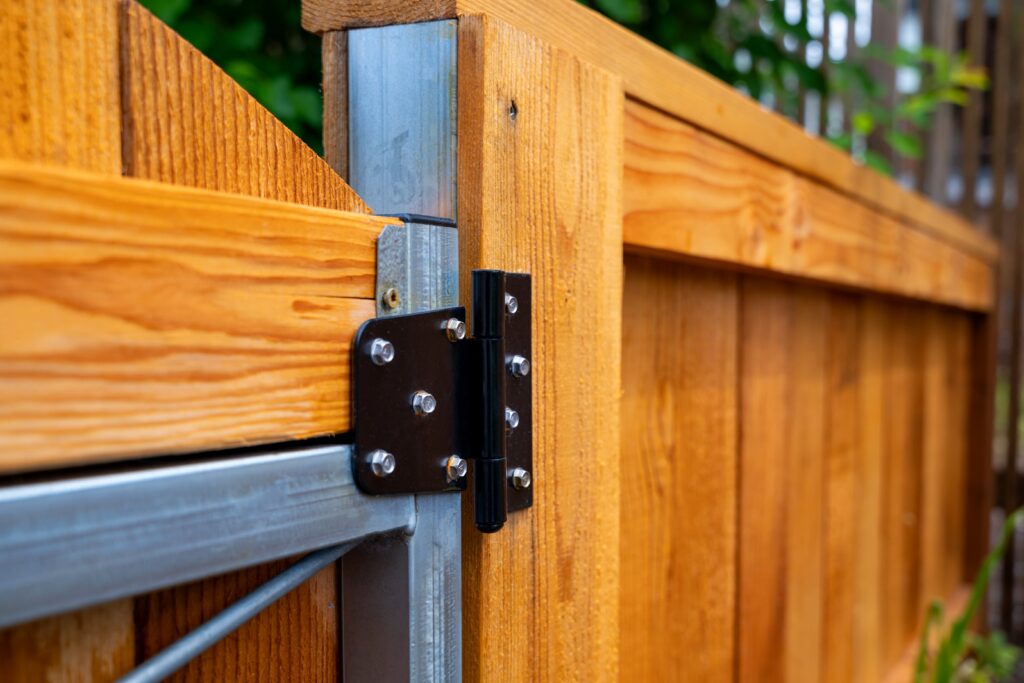
Instead of wood frame gates, we recommend steel frame gates.
The reason is simple. Steel holds its shape better.
Kurt explained it this way:
“The big thing is they will last. They don’t warp and twist.”
That is the main difference. A wood frame gate can absorb moisture, dry out, twist, and move. Steel does not react the same way. It stays square much better over time.
That matters because once a gate gets out of square, everything else starts to struggle. The hinges carry weight unevenly. The latch stops lining up. The bottom of the gate may start dragging. The whole gate becomes harder to use.
Kurt said:
“Steel frame is absolutely the way to go.”
For us, this is one of the biggest parts of building a gate that lasts. We want the gate to still work years from now, not just look good on install day.
We use strong gate posts
A good gate needs more than a good frame. It also needs strong posts.
The posts are what carry the gate. If they twist, lean, rot, or move, the gate moves with them.
Kurt explained that pressure-treated wood posts are tempting because they are easy to find and inexpensive. But they are not what we recommend for a long-lasting gate.
He said:
“Your pressure-treated posts are not your grandpa’s pressure-treated posts.”
In other words, the material has changed over time, and we see modern pressure-treated posts twist and move more than homeowners expect.
For regular fence sections, post strength still matters. But for gates, it matters even more. A gate post is under more stress than a normal fence post because it is holding a moving section of fence.
Kurt said:
“The gate posts need to be sturdy and strong.”
For a standard four-foot pedestrian gate, Kurt said we typically use a two-and-a-half-inch square steel post. For larger gates, we go bigger.
He explained:
“For an eight-foot gate, we go four inch, and then for out to a 12-foot or a 15-foot single swing, we go six inches and even more.”
That might sound like overkill, but that is the point. Gates need to be built stronger than most people think.
We use quality hinges and latches
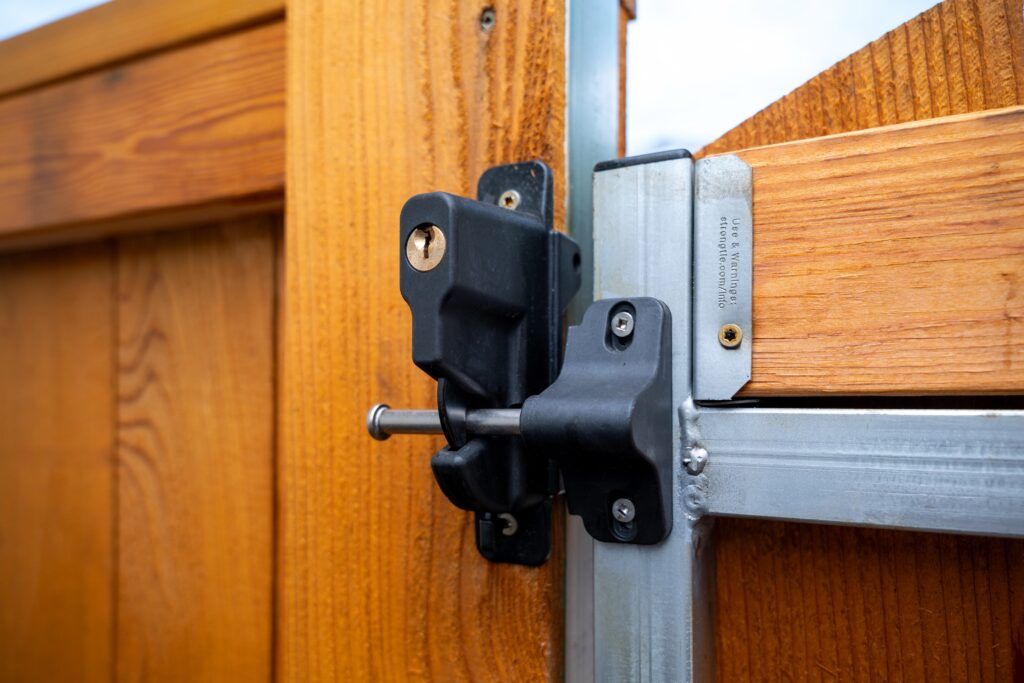
Gate hardware is another place where people often make mistakes.
It is easy to shop for hinges and latches based on looks. There are plenty of options online that look nice in a picture. But a gate hinge has a job to do. A latch has a job to do. If those parts are not strong enough, the gate will not work the way it should.
Kurt said:
“A lot of people will buy off looks, and not on strength or durability.”
That is where problems start.
A pretty hinge is not helpful if the gate sags. A decorative latch is not worth much if it does not line up. Hardware needs to be chosen for the weight of the gate, the weather, and the amount of use it will get.
Kurt summed it up well:
“Reliability has a beauty of its own.”
That is how we think about gate hardware. It should look good, but it needs to work first.
We build the whole gate as a system
One of the most important things Kurt talked about is that a long-lasting gate is not about one single part. It is the whole system.
You need strong posts.
You need a steel frame.
You need quality hinges.
You need a reliable latch.
You need the right size.
If one part is weak, the whole gate can suffer.
Kurt stated:
“If you have any cheap parts or products on it, within two or three years it’ll come back to haunt you.”
That is why we are picky about our gates. It is not because we want to make things complicated. It is because we have seen what happens when one part of the gate is not built for the long term.
A gate is only as good as its weakest point.
We help homeowners choose the right gate size
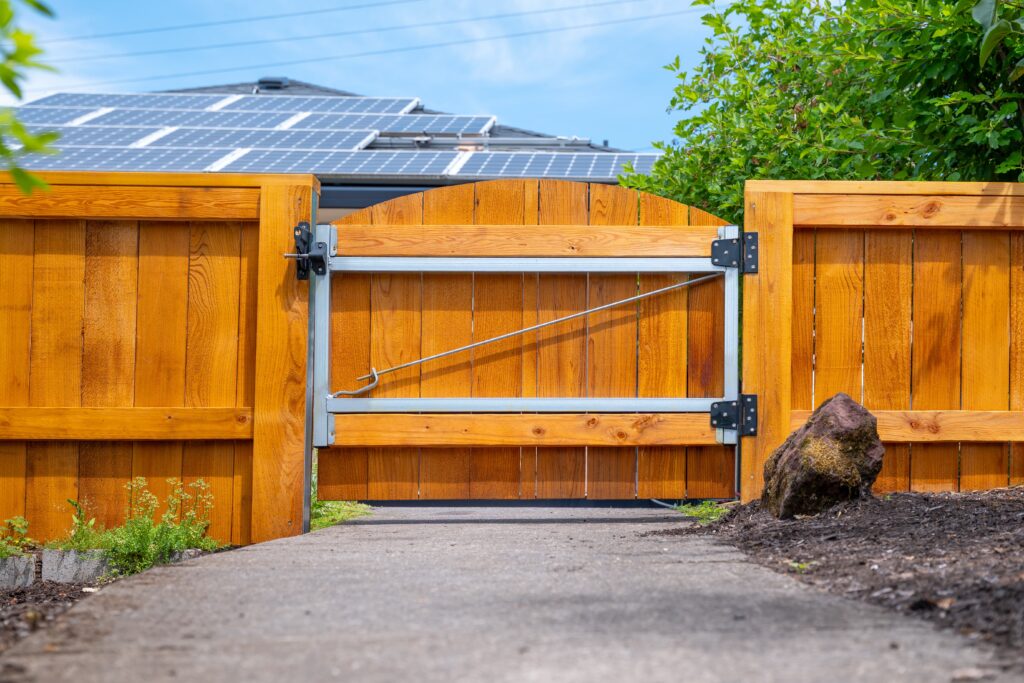
Another common mistake is building the gate too small.
A lot of people think only about walking through the gate. But that is usually not the only thing a gate needs to do.
Kurt said homeowners should think about “the biggest possible thing you could put back there.”
That might mean garbage cans, lawn equipment, dirt bikes, motorcycles, wheelbarrows, trailers, boats, or an RV. It could also mean future plans. Maybe you want to add a concrete pad later. Maybe you plan to store a trailer behind the fence someday. Maybe you do not need a wider gate right now, but you will later.
Kurt explained that a good fence can last 20 to 25 years if it is built right. That means the gate should be planned with the future in mind too.
He called it “using your crystal ball for gate size.”
That is a good way to think about it. A gate is much easier to size correctly before the fence is built than after.
Your gate does not have to match your fence exactly
A lot of homeowners assume the gate has to look exactly like the rest of the fence. It can, but it does not have to.
Sometimes a unique gate can make the yard look better. It can create a focal point, mark an entrance, or make the space feel more intentional.
Kurt said:
“Your gate doesn’t have to match your fence.”
This is especially true when homeowners want their landscaping or outdoor space to feel more designed. A gate can be practical and still add character.
The main thing is that the gate needs to work. Style matters, but function comes first.
What to ask your contractor about gates
If you are talking with a contractor about a new fence gate, Kurt recommends asking about the main parts of the gate system.
He said:
“I want steel gate posts, I want a steel frame, and I want high quality latches and hardware.”
That is a simple checklist, and it is a good one.
Before your gate is built, ask:
What kind of frame will the gate have?
What kind of posts will support it?
What hinges will be used?
What latch will be used?
Will the gate be wide enough for how I use my yard?
What happens if the gate starts dragging or stops latching?
Those questions can help you avoid a lot of frustration later.
Our gates come with a lifetime warranty
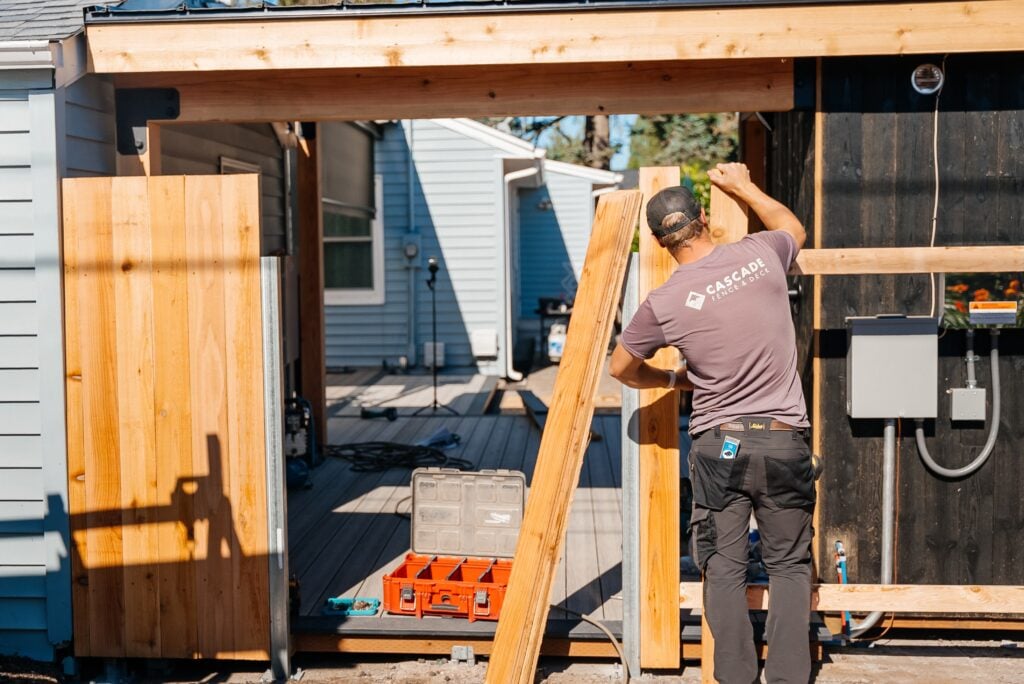
At Cascade Fence & Deck, we offer a lifetime warranty on our gates.
That warranty is one of the reasons we care so much about building gates the right way from the start.
Kurt said:
“We’re very motivated to make sure it’s installed right the first time.”
That is exactly right. If your gate drags on the ground, stops latching, or becomes hard to use, we do not want that for you. We want the gate to work the way it should.
Kurt explained:
“If it ever drags on the ground, if you’re ever fighting it open, if it’s not latching correctly, we will come back and we will fix it.”
That is why we do not cut corners on gate frames, posts, hinges, or latches. We want to build something that lasts.
The goal is a gate you do not have to think about
A good gate should not be something you fight with.
You should not have to lift it to make it latch. You should not have to kick it open. You should not have to warn guests that it sticks. You should not have to worry about the dog getting out because the latch does not catch.
The best gate is one you barely think about because it just works.
That is what we are trying to build.
As Kurt put it:
“If you can’t get in and out easily, you don’t like it.”
A fence gate is one of the most important parts of the fence. When it is built right, it makes your yard easier to use every day. When it is built wrong, it becomes a daily frustration.
That is why we build our gates with steel frames, strong posts, quality hardware, and long-term use in mind.